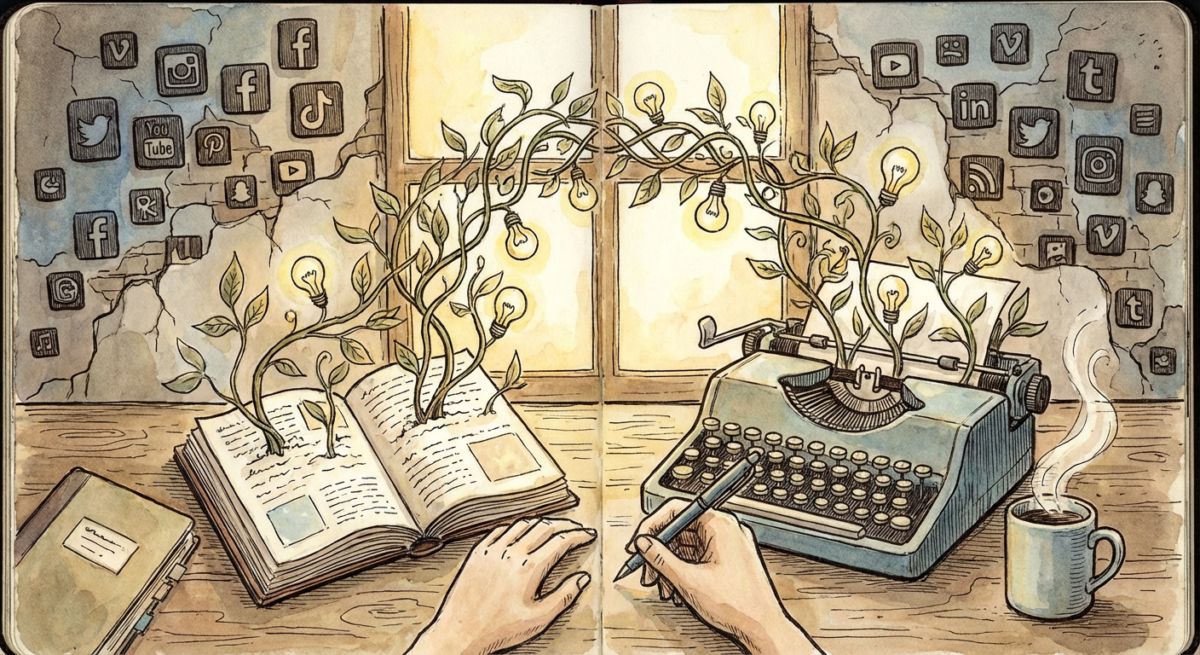
The Laboratory on My Kitchen Table
Every morning, I sit at my kitchen table with a cup of coffee and a notebook that looks nothing like the pristine bullet journals flooding Instagram. The pages are messy, filled with crossed-out thoughts, doodles in the margins, and questions I’m still trying to answer. This isn’t the kind of journaling that spawns million-dollar stationery empires or generates viral TikTok content about gratitude practices. This is something messier and more honest: a process notebook where I document not just what happens to me, but how I’m learning to think through what it all means.

I started calling it a process notebook because that’s what it really is. A laboratory for testing ideas about how to live. A place to examine the small experiments I’m running on myself daily, weekly, monthly. The word “journal” felt too precious, too loaded with expectations of profound insights or perfect penmanship. Process feels more accurate. It acknowledges that most of what I’m doing here is figuring things out as I go, documenting the work of becoming rather than celebrating the achievement of having become.
The Science of Writing It Down
There’s something fascinating happening when we translate internal experience into written words. Research consistently shows that regular journaling reduces cortisol levels and enhances working memory, suggesting that the act of writing helps our brains process and organize information more effectively. But beyond the measurable benefits lies something harder to quantify: the way writing forces us to slow down and examine our own thinking processes.
When I write about a difficult conversation or a moment of confusion, I’m not just recording what happened. I’m creating space to understand why I responded the way I did, what assumptions I was carrying, and what I might try differently next time. The notebook is a mirror that reflects not just events, but the patterns of thought and reaction that shape how I move through the world. This kind of self-reflection doesn’t require therapeutic frameworks or structured prompts, though those have their place.
What matters most is the commitment to showing up consistently with curiosity about your own experience. The habit-building wisdom that James Clear habit building teaches applies beautifully here: small, consistent actions compound over time into significant insight and change.
Beyond Gratitude Lists and Morning Pages
The personal development world has given us frameworks for journaling that can be incredibly helpful. Gratitude practices, backed by some of the strongest research in positive psychology, genuinely improve wellbeing and life satisfaction. Morning pages clear mental clutter. Bullet journaling systems help organize both thoughts and tasks. But sometimes these structured approaches can feel constraining, as if there’s a right way to examine your own life.
My process notebook rebels against this structure while borrowing from it selectively. Some days I write gratitude lists. Other days I rant about frustrations or puzzle through creative problems. Sometimes I copy quotes that struck me or sketch out half-formed ideas for projects. The only rule is honesty about what I’m actually thinking and feeling, not what I think I should be thinking and feeling.
This approach acknowledges that making meaning from our lives isn’t a linear process. We don’t move steadily from confusion to clarity, from problem to solution. Instead, we circle back to the same questions with slightly different perspectives, gradually building understanding through repetition and variation. The notebook captures this circling, this spiraling deeper into questions that matter.
Reclaiming the Narrative
In an era when social media platforms shape how we present and even understand our own experiences, there’s something powerful about returning to private, unfiltered writing. The current renaissance of personal blogging and long-form writing on platforms like Substack suggests that many people are hungry for more authentic ways to process and share their stories. We’re discovering that the careful curation required by social platforms can distance us from our own authentic experiences.
The process notebook offers a different relationship with narrative. Here, you don’t need to craft a coherent story or present a polished version of yourself. You can be contradictory, confused, and uncertain. You can document the messy middle of figuring things out rather than only the clean endings. This kind of writing resembles the approach taken by thoughtful writers like those featured in The Marginalian long-form writing, where thinking is presented as an ongoing process rather than a finished product.
When we reclaim our narratives from the pressure to perform understanding, we create space for genuine discovery. The notebook is a place where we can think thoughts we didn’t know we had, where we can surprise ourselves with our own insights and contradictions.
The Collaborative Nature of Self-Reflection
Perhaps the most unexpected discovery in my years of process journaling is how collaborative the work feels. Even though I write alone, the act of putting thoughts on paper creates a dialogue between my current self and my past selves. I read entries from months or years ago and find myself in conversation with someone who shared my name but saw the world differently.
This internal collaboration extends outward too. The clearer I become about my own thinking processes, the more curious I become about others’ processes. The notebook makes me a better listener, a more thoughtful friend, a more engaged participant in the ongoing human project of trying to understand what we’re doing here together.
The real magic happens in the accumulation of small observations and questions over time. Patterns emerge that I never would have noticed in the moment. Themes develop that reveal what I actually care about versus what I think I should care about. The notebook is a record not just of what I’ve done, but of how I’ve grown in my capacity to think clearly about complex things.
I’m curious about your own experiments with reflection and making sense of things. What questions are you carrying? What patterns are you noticing in your own thinking? The process is always unfinished, always open to new discoveries, and somehow that incompleteness feels like the most honest thing about it.
