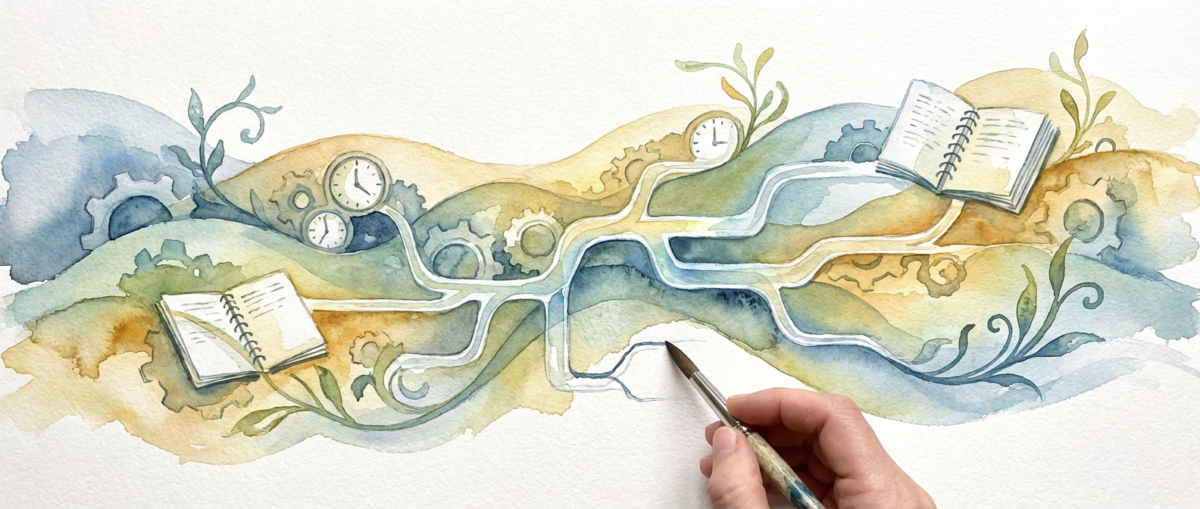
The Graveyard of Abandoned Systems
I have a folder on my computer labeled “Old Systems” that reads like an archaeological dig through my productivity obsessions. There’s the elaborate Notion dashboard I spent three weeks building and used for exactly nine days. The color-coded calendar system that made me feel like a kindergartner. The Getting Things Done setup that turned me into someone who spent more time organizing tasks than actually doing them. Each abandoned system is hours of setup time, a burst of initial enthusiasm, and the inevitable moment when I realized I was fighting the system instead of working with it.
What struck me recently, while scrolling through this digital graveyard, wasn’t the failure rate. It was something else entirely. Every single system I’d abandoned had one thing in common: they were all designed for a version of myself that didn’t actually exist. The person who would diligently update seventeen different project trackers. The person who thrived on visual complexity. The person who could remember to check five different apps throughout the day. I’d been building productivity systems for my aspirational self while completely ignoring my actual self.
This realization hit me hardest when I found screenshots of a task management setup I’d built last year. It was genuinely beautiful. Color-coded priorities, automated workflows, integration with every app I used. Looking at it felt like finding old photos of an ex-relationship where you remember thinking you were perfect together, but can now see all the ways you were fundamentally incompatible.
The Friction Points Nobody Talks About
Most productivity advice treats friction like it’s always bad, something to eliminate through better apps and smoother workflows. But I’ve started to think this is backwards. The friction points in my failed systems weren’t bugs, they were features trying to tell me something important about how I actually work.
Take my relationship with digital calendars. For years, I assumed I was bad at calendar management because I kept forgetting to check my phone. I downloaded apps with better notifications, tried different color schemes, even bought a smartwatch thinking the problem was access. But the real issue wasn’t the calendar. It was that I’m someone who thinks in chunks of time, not individual appointments. I need to see my day as a landscape, not a list of disconnected events.
The breakthrough came when I stopped fighting this tendency and started working with it. Instead of trying to become someone who checked their phone constantly, I created a morning ritual where I sketch out my day on paper. Literally draw it. Morning chunk, afternoon chunk, evening chunk, with the important stuff placed like landmarks. It takes two minutes and works with my brain instead of against it.
Similarly, I used to think I was undisciplined because I couldn’t stick to rigid time blocks. Pomodoro timers made me anxious. Time-boxing felt like wearing clothes that didn’t fit. But when I paid attention to my natural rhythm, I noticed I work in waves. Intense focus followed by mental wandering, then focus again. Now my “productivity system” includes planned wandering time. Revolutionary? Hardly. Effective for me? Completely.
The Questions That Changed Everything
The shift from building systems for imaginary-me to actual-me started with different questions. Instead of “What’s the best productivity system?” I began asking “What does productivity actually look like in my life?” Instead of “How can I optimize my workflow?” it became “What am I already doing that works, and how can I do more of that?”
These questions led me to notice patterns I’d been overlooking. I do my best thinking while walking, but I’d never built this into any system. I’m more creative in chaos than in pristine, organized environments, but I kept trying to impose laboratory-level organization on my workspace. I make better decisions when I sleep on them, but every productivity system I’d tried emphasized immediate action and quick decisions.
The most revealing question turned out to be: “When do I naturally feel productive, and what conditions make that happen?” Not when I should feel productive, or when productivity gurus say I should feel productive, but when I actually do. For me, it’s usually in coffee shops with moderate noise levels, working on something slightly more challenging than comfortable, with a looming but not crushing deadline. This isn’t optimal according to any productivity framework I know, but it’s true.
Once I started designing around these actual patterns instead of fighting them, something interesting happened. I stopped needing complex systems at all. When you’re working with your natural tendencies instead of against them, you need less scaffolding, not more.
What Actually Stuck (And Why)
My current “system,” if you can call it that, looks nothing like the elaborate constructions I used to build. There’s a small notebook where I write three things each morning: what I did yesterday that I want to do more of, what drained my energy that I want to do less of, and one specific thing I’m curious about today. That’s it. No apps, no automation, no color coding.
It works because it’s designed around three things I actually do consistently: I reflect naturally, I’m motivated by curiosity rather than obligation, and I respond better to gentle steering than rigid structure. It took me years to notice these patterns because I was too busy trying to fit myself into other people’s frameworks.
The notebook lives on my kitchen counter, not my desk, because I’ve learned I’m more likely to write in it during my coffee ritual than during “work time.” Some days I forget to write in it entirely, and that’s fine too. The system is robust enough to handle my inconsistency because it’s built on what I naturally do, not what I think I should do.
I still use apps and tools, but now they work for my actual workflow instead of trying to replace it. My calendar is deliberately sparse. My task management is mostly paper-based. My file organization would horrify efficiency experts, but I can find what I need because it reflects how I actually think about my work, not how I think I should think about it.
The Ongoing Experiment
Building productivity systems turns out to be less like engineering and more like gardening. You plant things, see what grows, and adjust based on what you observe. The “failed” systems weren’t really failures, they were experiments that taught me something about myself. The Notion dashboard taught me I don’t actually want to quantify everything. The color-coded calendar taught me visual complexity overwhelms rather than clarifies for me. The Getting Things Done experiment taught me I work better with less structure, not more.
I’m still experimenting, still noticing new patterns. Lately I’ve been curious about the relationship between physical space and mental clarity, so I’m trying different arrangements of my workspace. Not to optimize anything in particular, just to see what I notice. Maybe something useful will emerge, maybe not. The point is staying curious about how I actually work rather than how I think I should work.
What patterns have you noticed about when and how you work best? I’m genuinely curious, especially about the things that work for you but wouldn’t make sense to anyone else.
