There is a particular kind of clarity that comes from holding a tolerance in your hands. Not the abstract tolerance of a drawing—plus or minus five thousandths, say—but the physical fact of a shaft that will not enter a bore until you relieve it with a stone. The mind, when it is forced to reconcile intention with material, stops bullshitting. This is the connection between manual work and clear thinking, and it is not a metaphor. It is a consequence of feedback. The machinist who scrapes a bearing learns that the world does not care about his opinion. The mechanic who sets points by feel learns that a dwell meter is a convenience, not a substitute for attention. The welder who watches a puddle freeze learns that hesitation is a decision. These are not lessons you can get from a seminar.
In the Juniata River Valley, the West Branch Susquehanna, and the Route 22 corridor between Harrisburg and Pittsburgh, this connection was once so ordinary that nobody bothered to name it. It was simply what happened when you spent eight or ten hours a day in a shop, a garage, a foundry, or a mill. The work demanded a kind of thinking that was not verbal, not symbolic, but procedural and embodied. You thought with your hands, and your hands corrected your thoughts. The result was a mind that could hold a problem steady, turn it over, and see it for what it was. That kind of mind is not gone, but it is no longer assumed. It has become a specialty, like knowing how to butcher a hog or read a vernier scale.
What Manual Work Does to the Mind
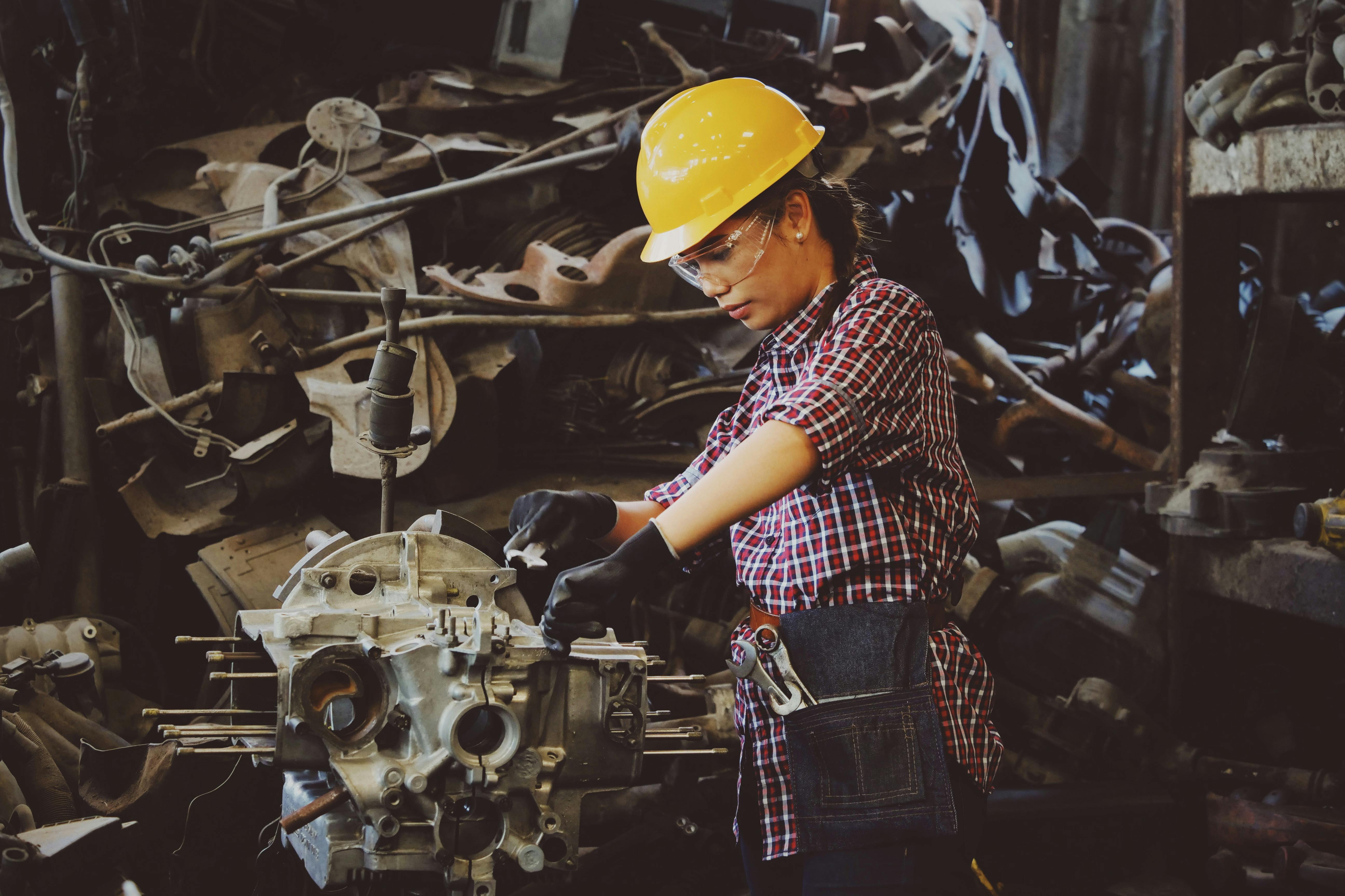
Manual work is often described as a refuge from thinking, a way to turn off the brain. That is exactly backwards. What it turns off is the chatter—the self-referential loop of worry, status, and hypotheticals that fills a mind with no external constraints. When you are under a truck with a rusted U-bolt, the chatter stops because the bolt does not care about your mood. The problem is real, immediate, and indifferent. You can solve it or you can walk away, but you cannot negotiate with it. This is the first gift of manual work: it forces the mind to attend to something other than itself.
The second gift is feedback. A carpenter who cuts a board too short learns the error in seconds, not in a quarterly review. A machinist who takes too heavy a cut hears the tool complain, feels the chatter through the handles, and sees the finish go to hell. The feedback is physical, immediate, and unambiguous. It trains the mind to connect cause and effect without the fog of interpretation. After enough years, this becomes a habit. You stop blaming the material, the tool, the boss, the weather. You look for the variable you control. That is clear thinking, and it is rare in offices because the feedback loops are long, noisy, and political.
The third gift is humility. Manual work teaches you that the world has a grain, a hardness, a temper, and a will of its own. You can learn to work with it, but you cannot wish it away. A casting with a void in it is not a personal insult. A bolt that snaps is not a moral failure. The work teaches you to distinguish between what you can change and what you must accept, and to do so without drama. This is the opposite of the therapeutic mindset that treats every obstacle as a story about you. The machinist does not ask what the broken tap means. He asks where the next one is and whether he should switch to a spiral flute.
The Shop as a School of Attention
In the shops I knew along Route 22—the small job shops, the engine rebuilders, the farm equipment dealers—there was a curriculum that nobody wrote down. It was taught by example, by correction, and by the occasional explosion of profanity that meant you had just learned something expensive. The first lesson was attention. You watched the old man set up a job, and you noticed that he did not rush. He cleaned the table, checked the parallels, indicated the vise, and only then touched the cutter. He was not being fussy. He was eliminating variables. A clear mind begins with a clean setup.
The second lesson was sequence. Manual work is full of order-of-operations problems. You cannot press a bearing onto a shaft after you have installed the seal. You cannot torque the head before you chase the threads. You cannot weld the bracket until you have fit it, and you cannot fit it until you have cleaned the joint. Learning to think in sequence is learning to think causally. It is the opposite of the associative, jump-cut thinking that digital media encourages. The shop teaches you that some things must come before other things, not because a rule says so, but because the material demands it.
The third lesson was economy. Not just economy of motion, but economy of thought. A good mechanic does not think about everything at once. He thinks about the next thing, and he trusts the sequence to carry him. This is not mindlessness; it is the opposite. It is the discipline of not wasting attention on what is not yet relevant. The old timers called it “staying ahead of the job.” It is a form of mental hygiene that is almost impossible to learn from a screen, because the screen is always interrupting you with what it thinks is relevant.

What the Deindustrialized Mind Lost
When the mills closed and the shops shrank, the region lost more than jobs. It lost a daily practice of clear thinking. The men and women who had spent their lives in the trades did not suddenly become stupid, but their children and grandchildren grew up without the shop as a school. They learned to think in classrooms and on screens, where feedback is delayed, ambiguous, and often social rather than physical. The result is a generation that is fluent in abstraction and clumsy with material. They can argue about systems but cannot fix a lawnmower. They can critique a process but cannot follow one.
This is not a moral failing. It is an environmental change. The shops that remain are smaller, more specialized, and often hidden. The big employers—the steel mills, the foundries, the railroad shops—are gone or reduced to ghosts. The Route 22 corridor is now a string of distribution centers and medical offices. The work that built the towns is now done elsewhere, by people we will never meet, in conditions we prefer not to imagine. The connection between manual work and clear thinking has not disappeared, but it has become a private practice, like prayer or fly fishing.
And yet the need for it has not diminished. If anything, the noise has gotten worse. The mind that never touches material is a mind that can be colonized by abstractions. It can be made to believe that a spreadsheet is a factory, that a policy is a product, that a meeting is work. The manual trades, even in their diminished state, remain a corrective. They remind us that some things are true whether or not we believe them, and that some problems cannot be solved by talking.
Clear Thinking in the Trades Today
The connection between manual work and clear thinking is not a historical curiosity. It is alive in the small shops that still dot the Juniata Valley and the West Branch. I have seen it in a one-man machine shop outside Lewistown, where the owner diagnoses a chatter problem by touching the workpiece while it spins. I have seen it in a garage in Huntingdon, where a mechanic finds an intermittent electrical fault by wiggling the wiring loom and listening for the change in idle. I have seen it in a welding shop in Mifflin County, where a fitter lays out a complex intersection with a soapstone and a tape measure, no CAD, no calculator, just a clear head and a steady hand.
These people are not relics. They are the living proof that the connection is real. They think differently than the people who manage them, not because they are smarter, but because their thinking is grounded in feedback. They know what they know because they have tested it against material. They are skeptical of theory, not because they are anti-intellectual, but because they have seen too many theories die on contact with a real workpiece. This skepticism is a form of clear thinking. It is the habit of asking, “How do you know?” and meaning it.
The trades also teach a kind of patience that is rare in a culture of instant gratification. You cannot rush a paint job. You cannot hurry a bearing break-in. You cannot force a tap through a blind hole. The work has its own tempo, and the clear mind learns to match it. This is not passivity. It is the recognition that some processes cannot be compressed without damage. The mechanic who tries to save time by skipping a step usually spends twice as long fixing the result. The machinist who takes a heavy cut to save a pass usually scrapes the part. The lesson is simple: respect the process, and the process will respect you.
How to Recover the Connection
If you did not grow up in a shop, you can still learn the connection between manual work and clear thinking. The entry points are everywhere, and they do not require a four-year degree or a trust fund. Buy a broken lawnmower and fix it. Take a welding class at the vo-tech. Volunteer at a railroad museum. Help a neighbor rebuild a deck. The point is not to become a professional; the point is to put your hands on something that pushes back.
Start with something small and mechanical. A bicycle, a chainsaw, a sewing machine. Take it apart, clean it, put it back together. Notice how your mind changes when you are holding a part and trying to understand why it fits. Notice how the chatter stops. Notice how the problem becomes clear, not because you thought harder, but because you stopped thinking about yourself and started thinking about the thing.
Then move to something that requires measurement. A woodworking project, a small engine rebuild, a plumbing repair. Learn to read a micrometer, a torque wrench, a feeler gauge. Learn to trust your hands as instruments. The goal is not to become a machinist; the goal is to recover the habit of checking your ideas against reality. That habit, once learned, transfers to everything else. You will find yourself asking better questions, rejecting vague answers, and noticing when someone is selling you an abstraction as if it were a fact.
The Limits of the Connection
I do not want to oversell this. Manual work is not a cure for everything. It will not make you wise, kind, or happy. It will not solve your marriage or your taxes. It can even make you worse in some ways: impatient with talk, intolerant of ambiguity, quick to dismiss what cannot be measured. The old machinists I knew were not saints. They were stubborn, opinionated, and often difficult. But they were clear. They knew what they knew, and they knew what they did not know. That is a rare thing, and it is worth recovering.
The connection between manual work and clear thinking is also not automatic. You can spend years in a shop and learn nothing but bad habits. You can be a hack with a wrench, a butcher with a torch, a slob with a mill. The work only teaches if you pay attention. The old timers used to say, “You can’t put a head on a man.” They meant that the work can only do so much. The rest is up to you. But the work gives you a chance. It gives you a place to practice attention, sequence, and economy. It gives you feedback that is honest. That is more than most of us get.
What This Means for the Region
The Juniata River Valley, the West Branch Susquehanna, and the Route 22 corridor are full of people who still know the connection between manual work and clear thinking. They are the ones who keep the water systems running, the bridges inspected, the trucks on the road. They are the ones who can look at a broken machine and see the path to fixing it. They are not celebrated, but they are essential. The region’s future depends on them, and on the young people who are willing to learn what they know.
That is why this blog exists. Not to mourn the past, but to document the present. To record the practices, the tools, the language, and the habits of mind that still survive in the shops and garages of central Pennsylvania. To show that the connection between manual work and clear thinking is not a lost art, but a living one. And to ask the question that matters: what happens when the last of the old timers is gone, and the knowledge is not passed on?
The answer is not inevitable. It depends on what we do now. We can let the connection fade, or we can rebuild it. We can treat the trades as a fallback for those who can’t do anything else, or we can treat them as a school of attention, a discipline of clear thinking, a way of being in the world. The choice is ours. The material is waiting.
Frequently Asked Questions
Is manual work really connected to clear thinking, or is that just nostalgia?
It is not nostalgia. The connection is based on feedback. Manual work gives you immediate, physical, unambiguous feedback on your decisions. That feedback trains the mind to connect cause and effect, to eliminate variables, and to distinguish between what you control and what you don’t. These are the habits of clear thinking. They can be learned elsewhere, but manual work teaches them with unusual force.
Do I need to become a professional tradesperson to get these benefits?
No. The benefits come from the practice, not the paycheck. You can get them by fixing a lawnmower, rebuilding a bicycle, or taking a welding class. The key is to work on something that pushes back, that requires measurement and sequence, and that gives you honest feedback. The more you do it, the more the habits transfer to other parts of your life.
What if I didn’t grow up around tools? Is it too late to learn?
It is never too late. Start small. Buy a broken appliance and take it apart. Watch a few videos, but don’t let the videos replace the work. The learning happens in your hands, not on the screen. Find a local vo-tech, a community college, or a neighbor who knows what they’re doing. Most tradespeople are happy to teach someone who is willing to listen and not afraid to get dirty.
Why does this matter for central Pennsylvania specifically?
Because this region was built on manual work, and the connection between that work and clear thinking is still alive here. The shops, garages, and farms of the Juniata Valley, the West Branch, and the Route 22 corridor are full of people who think with their hands. Documenting and preserving that connection is not just a historical project; it is a way of understanding what the region is and what it could become.
Next up: a look at the last independent machine shops in Mifflin County, and what they can teach us about the future of work.
