Personal essays, notes, and ideas worth sharing.

Author: Billie Rei Singer (page 10 of 12)

The Gap Between Making and Sharing

The Strange Pause Between Creation and Publication

I’ve been watching myself lately, and I’ve noticed something odd about the rhythm of creative work. There’s this specific moment that happens after you finish something—not when you’re done-done, but when you reach that first complete draft, that initial version that could theoretically be shared. You sit back. You look at it. And then something interesting happens: nothing.

The Gap Between Making and Sharing

Not nothing nothing. But a strange, suspended pause. I used to think this was procrastination or fear, and maybe sometimes it is. But I’ve started to suspect it’s something else entirely. Your brain needs time to shift gears from the internal conversation of making to the external conversation of sharing. The thing you just created exists in creator-brain language, and it needs translation time.

Last month I finished a piece I’d been wrestling with for weeks. Good wrestling, the kind where you’re solving problems and finding surprising connections. When I typed the last sentence, I felt that familiar completion-adjacent feeling. Then I saved the file, closed my laptop, and didn’t touch it for three days. Not because I didn’t like it, not because I was avoiding it. I just wasn’t ready to think about anyone else reading it yet.
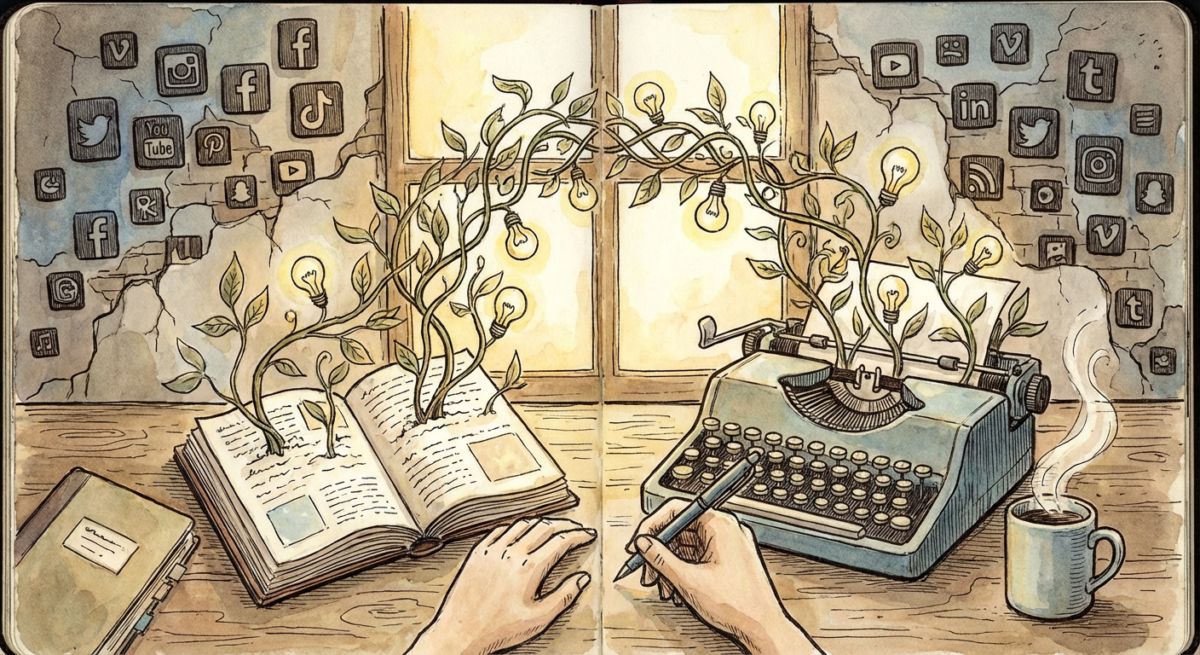
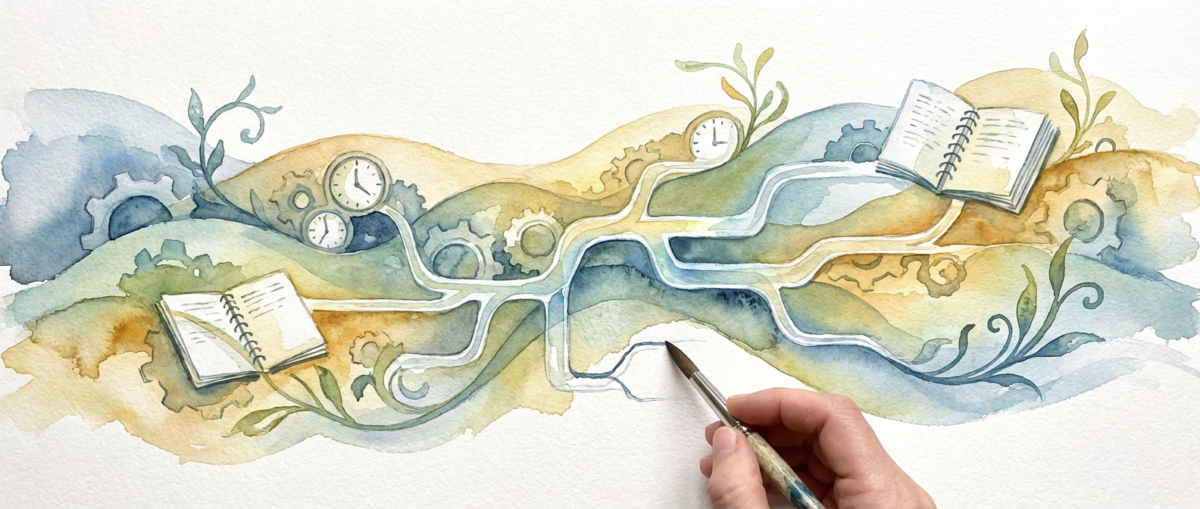
Illustration for The Gap Between Making and Sharing

The Two Different Brains

Making something and sharing something require completely different mental equipment. When I’m deep in creation mode, I’m having a conversation with the work itself. The piece tells me what it needs. I follow threads that seem promising, abandon others that fizzle out. I make decisions based on internal logic that’s often invisible to me until later. It’s intuitive, responsive, alive.

But sharing requires strategic thinking. Who is this for? How will they enter it? What context do they need? What might confuse them? Suddenly I’m not just in conversation with the work. I’m imagining conversations with readers I haven’t met. I’m trying to build bridges between my internal creative logic and someone else’s Tuesday afternoon attention span.

These aren’t better or worse than each other, but they are fundamentally different types of thinking. I’ve noticed that trying to do both simultaneously usually produces work that feels either self-indulgent or overly calculated. The sweet spot is letting each phase have its own space and time.

When Internal Logic Meets External Reality

Here’s what often happens in that translation pause: you realize that some of your favorite parts don’t actually work for anyone but you. That connection that felt so elegant? It requires knowledge your reader doesn’t have. That section that felt essential to the piece’s architecture? It’s actually a beautiful tangent that derails the main idea.

I have a folder on my computer called “Darlings” where I save the paragraphs I cut from pieces. Not because they’re bad—often they’re some of my most interesting writing—but because they help the internal conversation more than the external one. There’s something in there about the loneliness of creative decision-making, how you can love something and also know it doesn’t belong.

But here’s the thing I’m still figuring out: sometimes what feels like self-indulgent internal logic is actually the most interesting part for readers too. The challenge isn’t always simplifying or clarifying. Sometimes it’s trusting that the strange connections your brain made might be worth following, even if they require a little more work from your audience.

The Messy Middle of Professional Creating

If you create things professionally, this translation phase gets even weirder because there’s a third conversation happening: the business conversation. Not just “how do I share this?” but “how do I share this in a way that helps my career, builds my audience, fits my brand?” Suddenly you’re not just translating between creator-brain and reader-brain, but also thinking about SEO and social media angles and whether this piece positions you the way you want to be positioned.

I’ve watched myself get tangled up in this multi-layered thinking more times than I care to count. I’ll finish something I genuinely love, then spend days trying to figure out the “right” way to present it, until I’ve overthought myself into paralysis. The piece sits there, perfectly good but somehow untouchable because I can’t solve the puzzle of how to share it “correctly.”

What I’ve learned, slowly and imperfectly, is that the business conversation is legitimate but it can’t be the primary one. If I start with “how will this be received?” I usually end up with work that feels strategic but not alive. The trick is honoring the internal conversation first, then the reader conversation, then handling the business stuff as a separate, practical step.

The Permission to Be Unfinished

Maybe the most important thing I’ve noticed is how much creative work happens in public, even when we pretend it doesn’t. We share things that feel complete to us but are actually just complete enough to share. Then the real completion happens in response to how people engage with them—what questions they ask, what connections they make, where they push back or lean in.

This used to feel like failure to me, like I should have figured it all out before hitting publish. But I’m starting to think it’s actually how creative work is supposed to work. The internal conversation gets you to a place where the work can survive in the world. The external conversation is where it becomes whatever it’s actually going to become.

Which means that pause between making and sharing? Maybe it’s not procrastination or fear. Maybe it’s just your brain getting ready to let go of the thing you made so it can become the thing other people need it to be. And maybe that’s exactly as long as it needs to take.

I’m curious about your own creative rhythms. Do you notice this shift between making-brain and sharing-brain in your work? How long do you usually sit with something before you feel ready to let other people into the conversation?
The Thing I Noticed About Building Productivity Systems That Actually Stick

The Graveyard of Abandoned Systems

I have a folder on my computer labeled “Old Systems” that reads like an archaeological dig through my productivity obsessions. There’s the elaborate Notion dashboard I spent three weeks building and used for exactly nine days. The color-coded calendar system that made me feel like a kindergartner. The Getting Things Done setup that turned me into someone who spent more time organizing tasks than actually doing them. Each abandoned system is hours of setup time, a burst of initial enthusiasm, and the inevitable moment when I realized I was fighting the system instead of working with it.

The Thing I Noticed About Building Productivity Systems That Actually Stick

What struck me recently, while scrolling through this digital graveyard, wasn’t the failure rate. It was something else entirely. Every single system I’d abandoned had one thing in common: they were all designed for a version of myself that didn’t actually exist. The person who would diligently update seventeen different project trackers. The person who thrived on visual complexity. The person who could remember to check five different apps throughout the day. I’d been building productivity systems for my aspirational self while completely ignoring my actual self.

This realization hit me hardest when I found screenshots of a task management setup I’d built last year. It was genuinely beautiful. Color-coded priorities, automated workflows, integration with every app I used. Looking at it felt like finding old photos of an ex-relationship where you remember thinking you were perfect together, but can now see all the ways you were fundamentally incompatible.

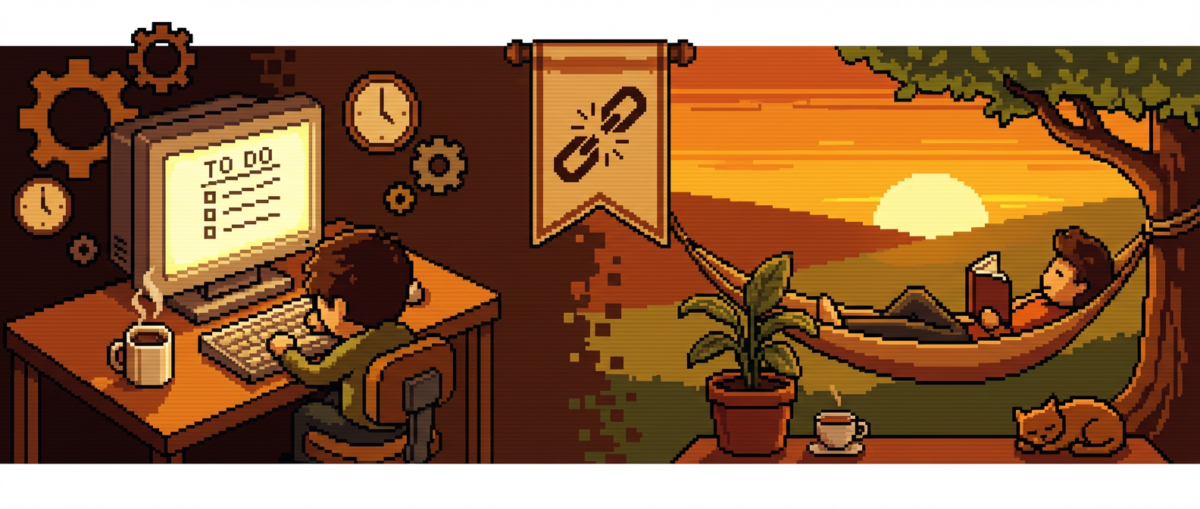
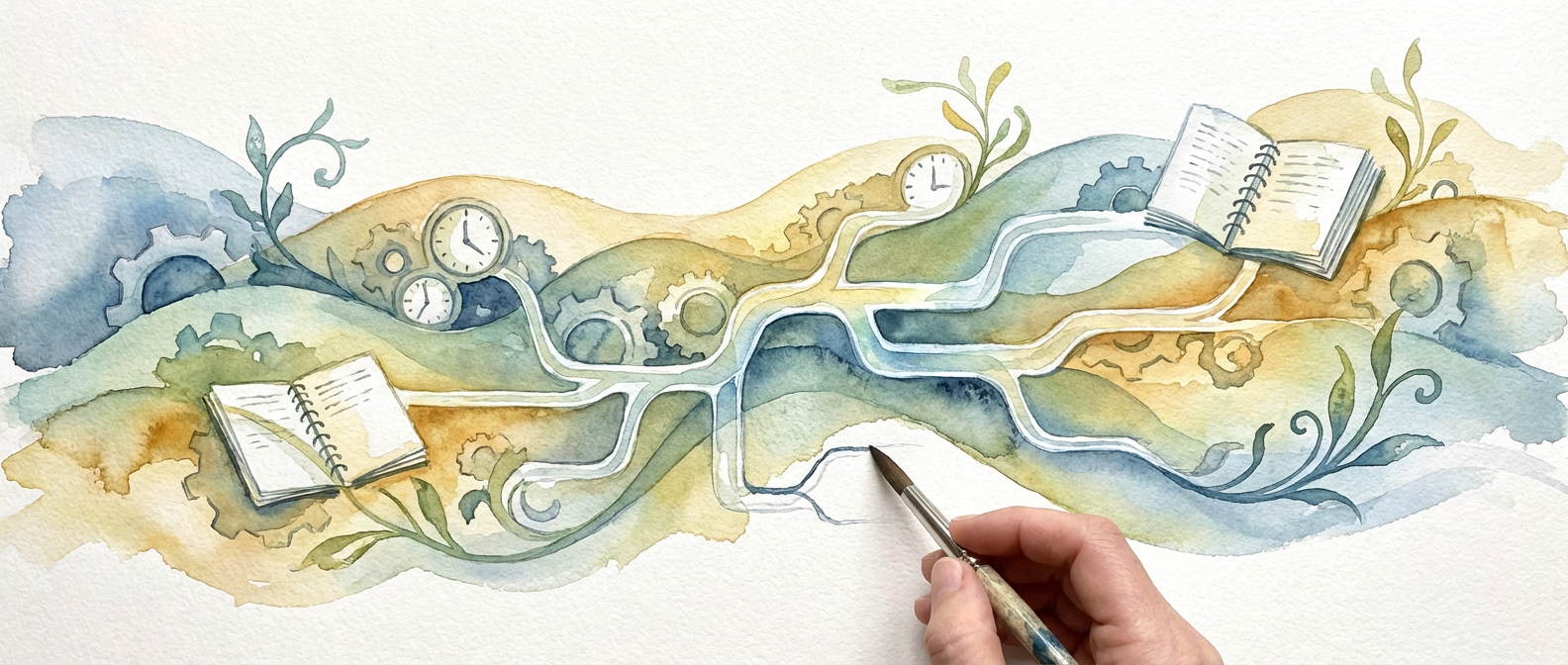
Illustration for The Thing I Noticed About Building Productivity Systems That Actually Stick

The Friction Points Nobody Talks About

Most productivity advice treats friction like it’s always bad, something to eliminate through better apps and smoother workflows. But I’ve started to think this is backwards. The friction points in my failed systems weren’t bugs, they were features trying to tell me something important about how I actually work.

Take my relationship with digital calendars. For years, I assumed I was bad at calendar management because I kept forgetting to check my phone. I downloaded apps with better notifications, tried different color schemes, even bought a smartwatch thinking the problem was access. But the real issue wasn’t the calendar. It was that I’m someone who thinks in chunks of time, not individual appointments. I need to see my day as a landscape, not a list of disconnected events.

The breakthrough came when I stopped fighting this tendency and started working with it. Instead of trying to become someone who checked their phone constantly, I created a morning ritual where I sketch out my day on paper. Literally draw it. Morning chunk, afternoon chunk, evening chunk, with the important stuff placed like landmarks. It takes two minutes and works with my brain instead of against it.

Similarly, I used to think I was undisciplined because I couldn’t stick to rigid time blocks. Pomodoro timers made me anxious. Time-boxing felt like wearing clothes that didn’t fit. But when I paid attention to my natural rhythm, I noticed I work in waves. Intense focus followed by mental wandering, then focus again. Now my “productivity system” includes planned wandering time. Revolutionary? Hardly. Effective for me? Completely.

The Questions That Changed Everything

The shift from building systems for imaginary-me to actual-me started with different questions. Instead of “What’s the best productivity system?” I began asking “What does productivity actually look like in my life?” Instead of “How can I optimize my workflow?” it became “What am I already doing that works, and how can I do more of that?”

These questions led me to notice patterns I’d been overlooking. I do my best thinking while walking, but I’d never built this into any system. I’m more creative in chaos than in pristine, organized environments, but I kept trying to impose laboratory-level organization on my workspace. I make better decisions when I sleep on them, but every productivity system I’d tried emphasized immediate action and quick decisions.

The most revealing question turned out to be: “When do I naturally feel productive, and what conditions make that happen?” Not when I should feel productive, or when productivity gurus say I should feel productive, but when I actually do. For me, it’s usually in coffee shops with moderate noise levels, working on something slightly more challenging than comfortable, with a looming but not crushing deadline. This isn’t optimal according to any productivity framework I know, but it’s true.

Once I started designing around these actual patterns instead of fighting them, something interesting happened. I stopped needing complex systems at all. When you’re working with your natural tendencies instead of against them, you need less scaffolding, not more.

What Actually Stuck (And Why)

My current “system,” if you can call it that, looks nothing like the elaborate constructions I used to build. There’s a small notebook where I write three things each morning: what I did yesterday that I want to do more of, what drained my energy that I want to do less of, and one specific thing I’m curious about today. That’s it. No apps, no automation, no color coding.

It works because it’s designed around three things I actually do consistently: I reflect naturally, I’m motivated by curiosity rather than obligation, and I respond better to gentle steering than rigid structure. It took me years to notice these patterns because I was too busy trying to fit myself into other people’s frameworks.

The notebook lives on my kitchen counter, not my desk, because I’ve learned I’m more likely to write in it during my coffee ritual than during “work time.” Some days I forget to write in it entirely, and that’s fine too. The system is robust enough to handle my inconsistency because it’s built on what I naturally do, not what I think I should do.

I still use apps and tools, but now they work for my actual workflow instead of trying to replace it. My calendar is deliberately sparse. My task management is mostly paper-based. My file organization would horrify efficiency experts, but I can find what I need because it reflects how I actually think about my work, not how I think I should think about it.

The Ongoing Experiment

Building productivity systems turns out to be less like engineering and more like gardening. You plant things, see what grows, and adjust based on what you observe. The “failed” systems weren’t really failures, they were experiments that taught me something about myself. The Notion dashboard taught me I don’t actually want to quantify everything. The color-coded calendar taught me visual complexity overwhelms rather than clarifies for me. The Getting Things Done experiment taught me I work better with less structure, not more.

I’m still experimenting, still noticing new patterns. Lately I’ve been curious about the relationship between physical space and mental clarity, so I’m trying different arrangements of my workspace. Not to optimize anything in particular, just to see what I notice. Maybe something useful will emerge, maybe not. The point is staying curious about how I actually work rather than how I think I should work.

What patterns have you noticed about when and how you work best? I’m genuinely curious, especially about the things that work for you but wouldn’t make sense to anyone else.

The Projects That Broke Me (And What I’m Still Figuring Out)

The App That Never Launched

In January, I was absolutely convinced I’d cracked the code on habit tracking. Not another generic app, but something that would use behavioral psychology to actually help people stick to their goals. I spent four months building what I thought was going to be my breakthrough project. The interface was clean, the gamification was subtle but effective, and I’d even figured out how to sync data across devices without making users create yet another account.

The Projects That Broke Me (And What I'm Still Figuring Out)
The Projects That Broke Me (And What I’m Still Figuring Out)

The beta testers were polite. Too polite. They said things like “interesting approach” and “I can see the potential.” When I pressed for specifics about what wasn’t working, they gave me feature requests instead of honest feedback about the fundamental problem: nobody actually wanted what I’d built. I’d solved a problem that existed mainly in my head, created for an audience of people exactly like me who were already obsessed with optimization.

I kept the code repository. Sometimes I still look at it, not with nostalgia but with genuine curiosity about where exactly I went wrong. The technical execution was solid. The user research, in retrospect, was almost entirely theoretical. I’d read studies about habit formation and user engagement, but I’d never actually sat with someone while they tried to build a new habit using existing tools. I’d built in isolation, and it showed.

The hardest part wasn’t losing the time I’d invested. It was realizing how much I’d been avoiding the uncomfortable work of talking to real users because I was afraid they might not want what I was excited to build. That fear of invalidation led me to build something that was, ultimately, invalid anyway.

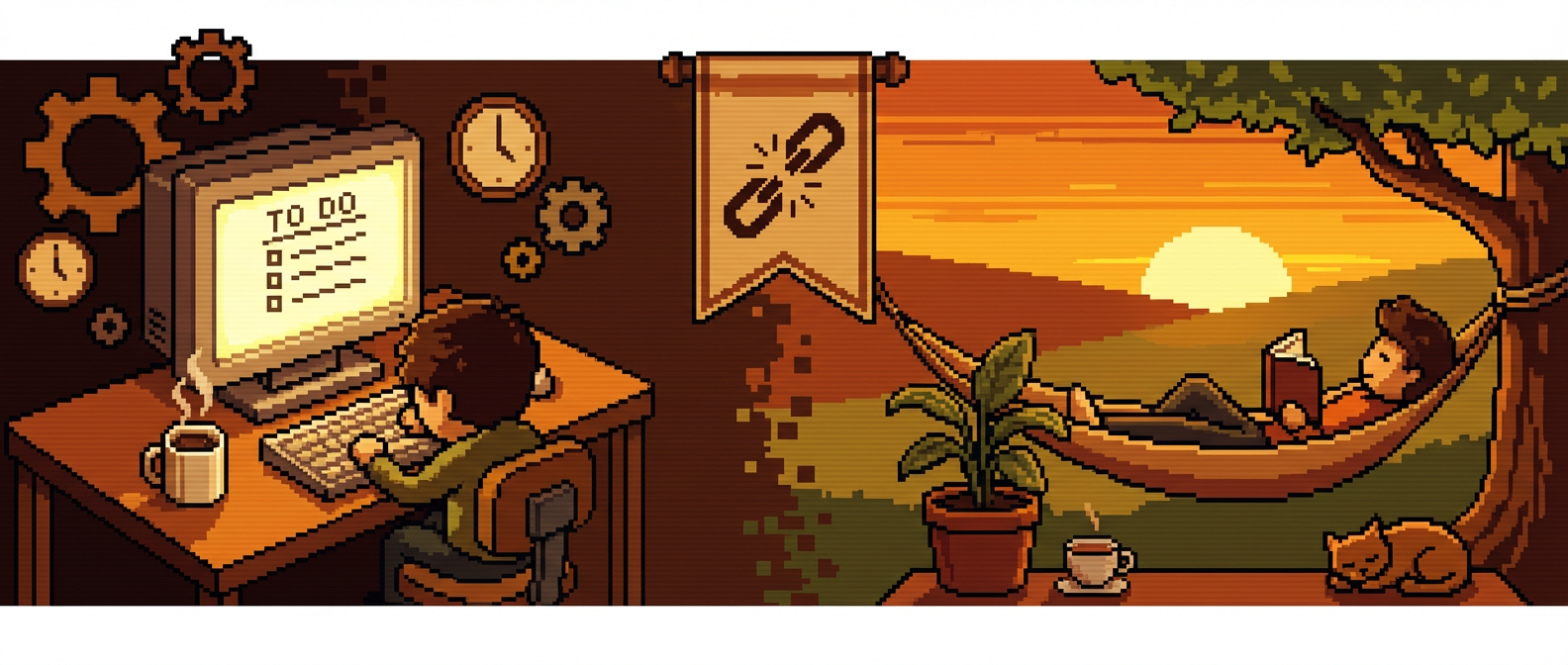
Illustration for The Projects That Broke Me (And What I'm Still Figuring Out)
Illustration for The Projects That Broke Me (And What I’m Still Figuring Out)

The Course That Taught Me Nothing

June brought what I thought would be a pivot toward something more sustainable: creating an online course about project management for creative freelancers. The market research looked promising. I had the expertise. I’d even pre-sold a few spots to gauge interest. Everything pointed toward this being the smart, logical next move after the app debacle.

I recorded forty-three videos over two months. Each one felt like pulling teeth. I kept telling myself it was normal to feel disconnected from the material, that enthusiasm would come once I saw students engaging with the content. I created worksheets and templates and even designed a private community space where students could share their progress.

The first cohort launched in September with twelve students. Within three weeks, half had stopped showing up to the weekly calls. The ones who stayed were polite and engaged, but I could tell something fundamental was missing. The content was useful enough, but it lacked any spark of genuine excitement. I was teaching things I knew intellectually but hadn’t internalized emotionally.

By October, I’d refunded everyone and shut down the course. The students were understanding, almost relieved. One told me she could sense that my heart wasn’t in it, and while the information was valuable, she’d rather learn from someone who was genuinely passionate about the subject. She wasn’t wrong. I’d chosen the topic because it seemed commercially viable, not because it lit me up inside.

The Newsletter That Nobody Missed

The newsletter felt like the safest bet. Low stakes, direct connection with readers, minimal technical overhead. I’d been writing sporadically for years and had a modest but engaged following. Converting that into a regular newsletter with premium subscription tiers seemed like the natural evolution of my online presence.

For six months, I published every Tuesday and Friday. The content was solid, occasionally even insightful. I covered productivity systems, creative process deep-dives, and behind-the-scenes looks at various projects. The free subscriber count grew slowly but steadily. The paid tier, however, remained stubbornly small.

The real wake-up call came when I took a two-week break in November. I’d been feeling burned out and decided to pause publication while I recharged. When I came back, exactly three people had asked where I’d been. Three. Out of nearly eight hundred subscribers. The silence wasn’t malicious or personal, but it was telling. I’d been creating content that was nice to have rather than essential to anyone’s week.

I kept publishing through December, but something had shifted. I could feel myself going through the motions, hitting publish not because I had something important to share but because Tuesday and Friday demanded content. The newsletter had become a treadmill that nobody particularly cared if I stepped off of.

What Failure Actually Teaches You

The conventional wisdom about failure is that it teaches you resilience, adaptability, and perseverance. That’s true but incomplete. What failure really teaches you is specificity. Not “I need to work harder” but “I need to validate demand before building features.” Not “I should be more passionate” but “I need to distinguish between topics I find intellectually interesting and work that genuinely energizes me.”

Each of these projects failed differently, but they all shared a common thread: I was optimizing for the wrong metrics. With the app, I optimized for technical elegance instead of user validation. With the course, I optimized for market opportunity instead of personal alignment. With the newsletter, I optimized for consistency instead of necessity.

The other thing failure teaches you is patience with the messy middle of figuring things out. I used to think that successful people had some special insight that let them skip past the trial and error phase. Now I suspect they just get comfortable with longer cycles of experimentation. They’re willing to fail at a higher level of sophistication.

There’s also something oddly liberating about accumulating a decent collection of well-documented failures. It makes you less precious about new ideas and more willing to test them quickly and cheaply. When you’ve already proven you can survive building the wrong thing, the stakes of any individual experiment feel more manageable.

The Experiments Still Running

I’m not done failing, obviously. Right now I’m working on a project that might be completely wrong for reasons I can’t see yet. It’s a tool for helping small teams document their decision-making processes, born from my own frustration with forgetting why we made certain choices six months ago. I’m being more careful about validation this time, but careful doesn’t guarantee correct.

The difference is that I’m keeping better notes about what I’m assuming and why. I’m talking to potential users earlier and more often, even when those conversations are uncomfortable. I’m trying to distinguish between the part of me that wants this tool to exist and the part that thinks other people need it.

Maybe this one will work. Maybe it’ll join the archive of noble attempts that taught me something important about building things people actually want. Either way, I’ll write about it honestly, including the parts that don’t fit neatly into a “lessons learned” framework.

What projects have you shelved this year? I’m genuinely curious about the things that didn’t work out, the assumptions that turned out to be wrong, the gaps between what you thought you were building and what you actually built. The internet has plenty of success stories, but there’s something valuable in the archives of our almost-solutions too.

The Process Notebook: How Daily Writing Became My Laboratory for Living

The Laboratory on My Kitchen Table

Every morning, I sit at my kitchen table with a cup of coffee and a notebook that looks nothing like the pristine bullet journals flooding Instagram. The pages are messy, filled with crossed-out thoughts, doodles in the margins, and questions I’m still trying to answer. This isn’t the kind of journaling that spawns million-dollar stationery empires or generates viral TikTok content about gratitude practices. This is something messier and more honest: a process notebook where I document not just what happens to me, but how I’m learning to think through what it all means.

The Process Notebook: How Daily Writing Became My Laboratory for Living

I started calling it a process notebook because that’s what it really is. A laboratory for testing ideas about how to live. A place to examine the small experiments I’m running on myself daily, weekly, monthly. The word “journal” felt too precious, too loaded with expectations of profound insights or perfect penmanship. Process feels more accurate. It acknowledges that most of what I’m doing here is figuring things out as I go, documenting the work of becoming rather than celebrating the achievement of having become.

The Science of Writing It Down

There’s something fascinating happening when we translate internal experience into written words. Research consistently shows that regular journaling reduces cortisol levels and enhances working memory, suggesting that the act of writing helps our brains process and organize information more effectively. But beyond the measurable benefits lies something harder to quantify: the way writing forces us to slow down and examine our own thinking processes.

When I write about a difficult conversation or a moment of confusion, I’m not just recording what happened. I’m creating space to understand why I responded the way I did, what assumptions I was carrying, and what I might try differently next time. The notebook is a mirror that reflects not just events, but the patterns of thought and reaction that shape how I move through the world. This kind of self-reflection doesn’t require therapeutic frameworks or structured prompts, though those have their place.

What matters most is the commitment to showing up consistently with curiosity about your own experience. The habit-building wisdom that James Clear habit building teaches applies beautifully here: small, consistent actions compound over time into significant insight and change.

Beyond Gratitude Lists and Morning Pages

The personal development world has given us frameworks for journaling that can be incredibly helpful. Gratitude practices, backed by some of the strongest research in positive psychology, genuinely improve wellbeing and life satisfaction. Morning pages clear mental clutter. Bullet journaling systems help organize both thoughts and tasks. But sometimes these structured approaches can feel constraining, as if there’s a right way to examine your own life.

My process notebook rebels against this structure while borrowing from it selectively. Some days I write gratitude lists. Other days I rant about frustrations or puzzle through creative problems. Sometimes I copy quotes that struck me or sketch out half-formed ideas for projects. The only rule is honesty about what I’m actually thinking and feeling, not what I think I should be thinking and feeling.

This approach acknowledges that making meaning from our lives isn’t a linear process. We don’t move steadily from confusion to clarity, from problem to solution. Instead, we circle back to the same questions with slightly different perspectives, gradually building understanding through repetition and variation. The notebook captures this circling, this spiraling deeper into questions that matter.

Reclaiming the Narrative

In an era when social media platforms shape how we present and even understand our own experiences, there’s something powerful about returning to private, unfiltered writing. The current renaissance of personal blogging and long-form writing on platforms like Substack suggests that many people are hungry for more authentic ways to process and share their stories. We’re discovering that the careful curation required by social platforms can distance us from our own authentic experiences.

The process notebook offers a different relationship with narrative. Here, you don’t need to craft a coherent story or present a polished version of yourself. You can be contradictory, confused, and uncertain. You can document the messy middle of figuring things out rather than only the clean endings. This kind of writing resembles the approach taken by thoughtful writers like those featured in The Marginalian long-form writing, where thinking is presented as an ongoing process rather than a finished product.

When we reclaim our narratives from the pressure to perform understanding, we create space for genuine discovery. The notebook is a place where we can think thoughts we didn’t know we had, where we can surprise ourselves with our own insights and contradictions.

The Collaborative Nature of Self-Reflection

Perhaps the most unexpected discovery in my years of process journaling is how collaborative the work feels. Even though I write alone, the act of putting thoughts on paper creates a dialogue between my current self and my past selves. I read entries from months or years ago and find myself in conversation with someone who shared my name but saw the world differently.

This internal collaboration extends outward too. The clearer I become about my own thinking processes, the more curious I become about others’ processes. The notebook makes me a better listener, a more thoughtful friend, a more engaged participant in the ongoing human project of trying to understand what we’re doing here together.

The real magic happens in the accumulation of small observations and questions over time. Patterns emerge that I never would have noticed in the moment. Themes develop that reveal what I actually care about versus what I think I should care about. The notebook is a record not just of what I’ve done, but of how I’ve grown in my capacity to think clearly about complex things.

I’m curious about your own experiments with reflection and making sense of things. What questions are you carrying? What patterns are you noticing in your own thinking? The process is always unfinished, always open to new discoveries, and somehow that incompleteness feels like the most honest thing about it.

The Productivity Paradox: Why Anti-Hustle Culture Is Missing the Point

The Great Productivity Rebellion Has Lost Its Way

We live in strange times when being productive has become controversial. The workplace rebellion that began with quiet quitting in 2022 continues to shape professional conversations four years later, morphing into a wholesale rejection of anything that smells like optimization or improvement. This anti-hustle backlash has swung so far in the opposite direction that we’re now suspicious of anyone who dares to suggest that working smarter might be worth pursuing.

The irony is thick. While millions discover the power of personal knowledge management through tools like Obsidian and Notion, transforming how they capture and connect ideas, the cultural narrative insists that caring about efficiency makes you a productivity bro. While over sixty company studies show that four-day work weeks maintain or improve output, we’re told that measuring results is inherently toxic. Something doesn’t add up here, and I suspect we’re throwing the baby out with the bathwater.

The real tragedy isn’t that people are rejecting hustle culture. Good riddance to the performative busyness and sleep-deprivation badges of honor. The tragedy is that in our rush to distance ourselves from toxic productivity, we’re abandoning the genuinely valuable pursuit of doing meaningful work well. We’ve confused the symptom with the disease. In doing so, we’re making ourselves less capable of the very thing we claim to want: a life of purpose and satisfaction.

When Burnout Became a Badge and Balance Became Boring

Since the World Health Organization officially recognized burnout as an occupational phenomenon in 2019, we’ve witnessed a curious cultural shift. What should have been a wake-up call about workplace toxicity became, for many, a reason to reject any systematic approach to getting things done. The pendulum swung from “sleep when you’re dead” to “caring about outcomes is capitalist brainwashing,” with little middle ground in between.

This reaction is understandable but misguided. The problem was never that people wanted to be effective at their work. The problem was the way hustle culture divorced productivity from humanity, treating people like machines that could be optimized for maximum output regardless of the human cost. Companies like Basecamp recognized this distinction early, building anti-meeting cultures that respect both results and human attention spans. They understood that true productivity isn’t about doing more things faster, but about creating space for the work that actually matters.

Yet somehow, in our collective trauma response to burnout culture, we’ve begun to view any intentional approach to work as suspect. The dopamine detox and digital minimalism movements grow as counter-cultural responses to our always-on world. But even these reasonable reactions to technology overwhelm get painted with the same broad brush of productivity skepticism. We’ve created a false binary where you’re either a mindful human being or a productivity-obsessed robot, with no possibility of being both thoughtful and effective.

The Quiet Revolution in How We Actually Work

While the cultural conversation rages about productivity versus humanity, something interesting is happening beneath the surface. Millions of people are quietly discovering that better systems actually create more freedom, not less. They’re using personal knowledge management tools to connect ideas across projects and years, building what amounts to external thinking systems that enhance rather than replace human creativity.

These aren’t the grinding, optimization-obsessed methods of hustle culture. They’re more like what you find in Cal Newport productivity writing or Paul Graham essays: thoughtful approaches to creating conditions where meaningful work can happen. The focus isn’t on cramming more tasks into each day. It’s on designing workflows that support deep thinking and sustained attention.

This underground productivity renaissance operates on different principles entirely. It prioritizes sustainability over speed, depth over volume, and intentionality over mere busyness. It recognizes that having better systems for managing information and attention isn’t about becoming more machine-like. It’s about becoming more fully human in our capacity to engage with complex, meaningful work over time.

The False Choice Between Caring and Being Human

Here’s what I think we’ve gotten wrong in our rush to reject productivity culture: we’ve accepted the premise that caring deeply about doing good work is somehow incompatible with having a balanced, fulfilling life. This is the exact lie that hustle culture sold us, just in reverse. Instead of “sacrifice everything for success,” we now hear “caring about results means you’ve been brainwashed by capitalism.”

Both positions miss the fundamental truth that humans are wired to find meaning through competence and contribution. We don’t feel fulfilled when we’re deliberately mediocre at things that matter to us. We feel fulfilled when we’re able to contribute our best thinking and effort to problems we care about, in sustainable ways that honor our full humanity.

The four-day work week studies prove this point beautifully. When companies focus on results rather than hours, and when they design systems that support rather than drain human energy, productivity doesn’t suffer. Often, it improves. This isn’t because people become productivity machines. It’s because they become more fully themselves: rested, focused, and energized to do work that matters.

The real choice isn’t between productivity and humanity. It’s between thoughtful systems that support human flourishing and mindless systems that only support the appearance of effort. One honors both our need for meaningful contribution and our need for sustainable, balanced lives. The other doesn’t help either.

Reclaiming Intentionality from the Productivity Wars

What if we stopped fighting about whether productivity is good or bad and started asking better questions? What if we asked how to design our days in service of both excellent work and rich living? What if we explored how better systems might actually create more space for spontaneity, creativity, and rest?

This isn’t about returning to hustle culture or embracing every productivity hack that promises to change your life. It’s about recognizing that intentionality and humanity aren’t opposing forces. You can care deeply about doing good work and also prioritize your relationships, health, and inner life. You can build systems that support your best thinking while also leaving room for inefficiency, play, and rest.

The anti-hustle backlash did something important. It helped us recognize the human costs of productivity culture run amok. But we don’t need to abandon the pursuit of effectiveness to reclaim our humanity. We need to pursue effectiveness in more human ways.

What does productivity look like in your life when it works for your whole self rather than just your output? I’m genuinely curious about the systems and approaches that help you do meaningful work while staying connected to what matters most. The conversation is far from over, and your experience might just reshape how we think about this entire mess.

The Thing I Noticed About Getting Things Done When Nobody Wants To Hustle Anymore

The Quiet Revolution in How We Think About Work

Something shifted in the last few years, and I keep noticing it everywhere I look. The phrase “quiet quitting” emerged in 2022 as a way to describe employees doing exactly what their job descriptions required and nothing more. Four years later, that term still dominates workplace conversations, but it has evolved into something deeper than workplace rebellion. It’s become a way of thinking about what productivity actually means when you strip away all the performance theater.

I started paying attention to this shift when I realized my own relationship with getting things done had fundamentally changed. The books I reached for were no longer about optimizing every minute or building elaborate systems to squeeze more output from my days. Instead, I found myself drawn to ideas about sustainable work, about building systems that worked for my life instead of eating it alive. This wasn’t laziness or a lack of ambition. It was something else entirely.

The numbers tell an interesting story. More than sixty companies have now tried four-day work weeks, and the results consistently show either neutral or positive impacts on productivity. These aren’t feel-good experiments or progressive company PR stunts. They’re serious attempts to test whether our assumptions about time and output actually hold up. The answer? They often don’t.

When Less Actually Works Better

The anti-hustle movement isn’t just about working less. It’s about working differently, and some of the most successful companies have been quietly proving this for years. Basecamp and its research arm Signal vs. Noise have championed an anti-meeting culture that prioritizes deep work over what they call collaborative theater. Their approach treats meetings as expensive interruptions rather than necessary evils, and their business results suggest this isn’t just wishful thinking.

What strikes me about this approach is how it aligns with what many individuals are discovering about their own productivity. The tools we choose reveal our priorities, and the rise of personal knowledge management systems like Obsidian and Notion tells a story about how millions of people now think about organizing their thoughts and work. These platforms reached massive adoption not because they promised to help users do more things, but because they offered better ways to think about the things worth doing.

I notice that these tools share something important with the anti-hustle philosophy. They emphasize connection and synthesis over accumulation. They help users build understanding rather than just compile information. This shift from quantity to quality shows up in how people approach their entire relationship with productivity.

The Counter-Culture of Intentional Limitation

Maybe the most telling sign of this broader change is the growth of movements that explicitly reject the more-is-better mentality. Dopamine detox and digital minimalism have evolved from niche practices to mainstream counter-culture movements. People are actively choosing to limit their inputs, to reduce their options, to constrain their possibilities because they value something more than maximum throughput.

This isn’t anti-technology sentiment or some back-to-the-land fantasy. Many practitioners of digital minimalism are deeply technical people who understand exactly what they’re giving up. When someone deletes social media apps or establishes phone-free hours, they’re running their own productivity experiment based on personal data about what actually helps them think and create.

The Cal Newport productivity writing that popularized many of these ideas resonates because it treats attention as a finite resource. But what I find most compelling about this approach is how it flips traditional productivity logic on its head. Instead of asking “How can I do more?” it asks “What deserves my attention?” The question itself changes everything about how we approach our work and days.

Burnout as a Design Problem

The World Health Organization recognized burnout as an occupational phenomenon in 2019, which was a big shift in how we understand the relationship between work and human capacity. Burnout isn’t a personal failing or a sign of insufficient optimization. It’s what happens when you design systems without considering human limitations. This has profound implications for how we think about sustainable productivity.

When I look at the productivity advice that dominated the previous decade, so much of it treated human energy as infinitely renewable. The focus was on techniques for pushing through resistance, for maintaining consistency regardless of circumstances, for optimizing every available moment. This approach assumed that the limiting factor in productivity was inefficiency rather than capacity.

The anti-hustle perspective suggests that our capacity for focused work, creative thinking, and sustained effort works more like muscle strength than machine performance. It can be developed, but it requires recovery. It can be focused, but not indefinitely. It can be optimized, but only within human constraints. This isn’t a limitation to overcome but a reality to design around.

What I’m Still Figuring Out

The tension between achievement and sustainability continues to fascinate me. Paul Graham essays often explore how exceptional work requires periods of intense focus and effort that might look very much like traditional hustle culture from the outside. But there’s something qualitatively different about choosing demanding work because it matters to you versus grinding through tasks because productivity culture demands it.

I think the anti-hustle backlash is really about reclaiming agency over our own attention and effort. It’s about distinguishing between productive work and busy work, between sustainable intensity and unsustainable optimization. The people I observe who navigate this balance well have developed strong internal filters for what deserves their best energy. They’ve learned to say no not just to obviously bad opportunities, but to merely good ones that don’t align with their deeper priorities.

This shift toward intentional productivity feels important, but I’m still watching to see how it plays out. What happens when a generation raised on optimization culture begins to prioritize sustainability? How do we maintain ambition while rejecting the pathologies of hustle culture? These questions don’t have simple answers, but they’re worth exploring. I’d love to hear how others are navigating this balance and what they’re discovering about productivity that actually works for their lives.

Journaling, self-reflection and meaning-making — An Honest Observation-led

This is one of those moments where paying attention changes what you do next. Journaling, self-reflection and meaning-making deserve more careful attention than most coverage provides. The reason isn’t complicated once you know where to look.

Here’s what most people miss, and it’s the part that matters most: bullet journaling just created a $200 million market in stationery and planners. When you actually examine the evidence, this tells a much more interesting story than you’d expect.

Journaling, self-reflection and meaning-making — An Honest Observation-led

The Essay: Setting the Terms

Studies show journaling reduces cortisol and improves working memory. This isn’t just another data point, it’s the foundation that makes everything else in this analysis make sense. This context doesn’t age quickly. The conditions creating it have been building for years, and their convergence makes right now different from previous moments that looked similar from a distance.

Look at bullet journaling creating that $200 million stationery market alongside therapy-adjacent journaling prompts getting millions of TikTok views. When you see both together, a pattern emerges that The Marginalian long-form writing has been tracking from the inside: these conditions are more durable than they first appear, and the implications go way beyond the immediate headlines.

To understand why this matters, compare what was true three years ago to what’s true now. The change isn’t just bigger numbers, it’s different in kind. The participants, the infrastructure, the incentive structures have all shifted in ways that build on each other rather than canceling out. That compounding effect is the most important thing to track.

What makes this moment worth examining isn’t its novelty but its confirmation. These underlying dynamics have been visible for some time. What’s new is they’ve reached a point where ignoring them takes active effort rather than simple inattention. Crossing that threshold is the real event, not the underlying movement that produced it.

And here’s the thing: gratitude journaling has the strongest RCT evidence of all positive psychology interventions. This isn’t separate from the other trends, it’s part of the same structural shift.

The Thing I Noticed: The Analysis

That evidence about gratitude journaling is where this gets more specific. The surface reading is accessible and not wrong, but it misses the mechanism. And the mechanism is where the practical insight lives. Here’s what most people miss: the mechanism is the personal blog renaissance as people reclaim narrative from social media. Understanding this changes what you do with the information.

Think about what this blog renaissance represents in context. It’s not a correlation that just happened to appear, it’s a consequence of structural factors that have been compounding. Previous readings of similar situations failed because they treated the symptom as the cause. The structural account is less satisfying as a headline but more useful for actual analysis.

Comparing this to prior cycles is instructive precisely because of where the comparison breaks down. Superficially similar conditions resolved differently before because the foundation was different. What we’re seeing with long-form personal essays finding audiences on Substack and Ghost represents a foundation change, the kind that alters how elastic the system is rather than just its current state. Recognizing that distinction separates real analysis from pattern-matching.

The skeptical counterargument deserves honest engagement: previous moments with similar surface characteristics didn’t produce the outcomes that seemed logical at the time. That history is real. What’s different now is long-form personal essays finding audiences on Substack and Ghost, which isn’t a minor variable, it’s the infrastructure condition that previous cycles lacked. Infrastructure changes tend to stick around in ways that sentiment-driven changes don’t. James Clear habit building is one source tracking this dimension with proper rigor.

There’s also a distribution question that often goes unaddressed in coverage of journaling, self-reflection and meaning-making: who captures the value created by these shifts, and who absorbs the disruption costs? The overall picture can be positive while the distribution is uneven in ways that matter enormously to specific participants. Keeping that lens in view is part of reading the situation clearly rather than just optimistically.

Implications: What This Means If You Care About Observations about creative life

The implications extend beyond the immediate context. Journaling reducing cortisol and improving working memory, combined with the structural conditions I’ve described, creates a situation where adjacent fields, decisions, and communities get affected in ways that aren’t always visible from inside the primary story. The second-order effects are frequently more important than the first-order ones, and they’re where careful attention pays the highest returns.

Here’s where this perspective departs from mainstream coverage: therapy-adjacent journaling prompts generating millions of TikTok views is a leading indicator rather than a lagging one. The people positioned to respond to what this signals, rather than what it confirms, will be less surprised by what follows.

The practical response depends heavily on your position relative to these dynamics. For those closest to the core of journaling, self-reflection and meaning-making, the implications are immediate and operational. For those at greater distance, the implications are strategic, a matter of understanding which adjacent pressures are building and which assumed stabilities are more fragile than they appear.

The practical question isn’t whether to engage with these dynamics but how. The answer depends on context, on what role you occupy relative to journaling, self-reflection and meaning-making and what your actual decision horizon is. But the first step is the same regardless: accurate understanding of what’s actually happening rather than what the most available narrative says is happening.

A few concrete observations are worth separating out from the broader analysis. First: bullet journaling creating a $200 million stationery market isn’t a temporary condition, it’s a new baseline. Second: the personal blog renaissance suggests the adjustment period isn’t over. Third, and most important: organizations and individuals treating the current moment as a new steady state rather than a transition are making a categorization error that will be costly to unwind later.

The Case Against: What the Critics Get Right

Intellectual honesty requires acknowledging the strongest counterarguments, not just the weakest ones. The case against the optimistic reading of journaling, self-reflection and meaning-making isn’t trivial. There are structural vulnerabilities in the current picture that deserve direct engagement rather than dismissal.

The most serious objection is about sustainability. Therapy-adjacent journaling prompts generating millions of TikTok views can be read not as a foundation but as a ceiling, a point beyond which growth becomes self-limiting because of the very dynamics that produced it. If the current state has already incorporated most of the available early-adopting participants, the remaining growth curve may be structurally shallower than the recent trajectory implies.

There’s also the policy and regulatory dimension. Studies showing journaling reduces cortisol and improves working memory describe conditions in a relatively permissive environment. Regulatory responses to the scale implied by these numbers aren’t inevitable, but they’re not implausible either. Organizations planning as though the current regulatory environment is permanent are making an assumption that the history of fast-growing sectors doesn’t support.

The rebuttal to these concerns isn’t that they’re wrong, it’s that they’re already partially priced into the current state of the field. Long-form personal essays finding audiences on Substack and Ghost reflects an environment where participants are already adapting to constraints rather than operating in an unconstrained space. The adjustment capacity of the ecosystem is higher than a purely top-down view of the risks suggests.

Looking Forward

The trajectory here is clearer than the pace. Making predictions about when specific thresholds will be crossed is genuinely difficult, and anyone claiming precision about timelines should be treated with skepticism. But the direction, toward continued journaling adoption and development of the conditions described above, is supported by evidence in a way that doesn’t depend on a single variable going right.

Long-form personal essays finding audiences on Substack and Ghost is the variable to watch as the leading indicator. Historical patterns suggest it moves first, with broader metrics following with some lag. This doesn’t make the outcome certain, but it makes it readable, and readability is the precondition for good decisions.

Three questions are worth holding as the story develops. First: are the structural conditions that enabled the current state durable, or are they cyclical? Second: who is positioned to benefit from the next phase, and does that differ materially from who benefited in the current phase? Third: what would clean falsification of the optimistic thesis look like, and is there any evidence of that signal emerging? These questions don’t need answers today, but having asked them changes what you notice in the months ahead.

The action from here is straightforward, even when the situation isn’t. The current moment in journaling, self-reflection and meaning-making is one where people who have built an accurate model of the underlying dynamics are better positioned than people relying on the surface story. Building that model isn’t a quick task, but it’s a tractable one, and this analysis is intended as one input into it.

What has this observation reminded you of?

Personal productivity and the anti-hustle backlash: Genuine recommendation

This is one of those moments where paying attention changes what you do next. The topic of personal productivity and the anti-hustle backlash deserves more careful attention than the typical coverage provides, and the reason isn’t complicated once you know where to look.

The part of this that most people miss is also the part that matters most: four-day work week trials showing productivity neutral or positive in 60+ company studies. When you look at the evidence, the situation becomes much clearer than most coverage suggests.

Personal productivity and the anti-hustle backlash: Genuine recommendation

The Recommendation: Setting the Terms

“Quiet quitting” was coined in 2022 and it’s still part of workplace conversations in 2026. That’s not just a data point in the story of personal productivity and the anti-hustle backlash, it’s the structural condition that makes everything else in this analysis make sense. Context like this doesn’t age quickly. The conditions that created it have been building for years, and the convergence is what makes this moment different from previous moments that looked similar from a distance.

Four-day work week trials showing productivity neutral or positive in 60+ company studies. Basecamp and Signal v. Noise’s anti-meeting culture gaining traction. When you look at both together, a pattern emerges that Paul Graham essays has been covering from the inside: the conditions are more durable than they first appear, and the implications extend further than the immediate headline suggests.

To understand why this matters, it helps to look at what was true three years ago versus what is true now. The change isn’t simply more of the same, it’s different in kind. The participants, the infrastructure, and the incentive structures have all shifted in ways that build on each other rather than cancel out. That compounding is the most important element to track.

What makes this moment worth examining carefully isn’t the novelty but the confirmation. The underlying dynamics have been visible for some time. What’s new is that they’ve reached a threshold where ignoring them requires active effort rather than simple inattention. That threshold crossing is the event, not the underlying movement that produced it.

And personal knowledge management tools like Obsidian and Notion reaching millions is part of that same picture. These elements don’t exist in separate silos, they’re reinforcing conditions in the same structural shift.

Illustration for Personal productivity and the anti-hustle backlash: Genuine recommendation

The Unsolicited Recommendation: The Analysis

Personal knowledge management tools like Obsidian and Notion reaching millions is where the analysis gets more specific. The surface reading is accessible and not wrong, but it misses the mechanism, and the mechanism is where the practical insight lives. The part of this that most people miss is also the part that matters most: the mechanism is dopamine detox and digital minimalism movements growing as counter-culture, and understanding it changes what you do with the information.

Consider what dopamine detox and digital minimalism movements growing as counter-culture represents in context. It’s not a correlation that happened to appear, it’s a downstream consequence of structural factors that have been compounding. Previous readings of similar situations failed because they treated the symptom as the cause. The structural account is less satisfying as a headline but more useful as an analytical tool.

The comparison to prior cycles is instructive precisely because of where it breaks down. Similar conditions resolved differently in previous iterations because the substrate was different. What burnout being recognised as an occupational phenomenon by WHO since 2019 represents is a substrate change, the kind that alters the elasticity of the system rather than just its current value. Recognising that distinction is what separates analysis from pattern-matching.

The skeptical counterargument deserves honest engagement: prior moments with similar surface characteristics didn’t produce the outcomes that seemed logical at the time. That history is real. What’s different now is burnout being recognised as an occupational phenomenon by WHO since 2019, which isn’t a minor variable, it’s the infrastructure condition that previous cycles lacked. Infrastructure changes tend to be persistent in ways that sentiment-driven changes are not. Cal Newport productivity writing is one source tracking this dimension with the rigour it requires.

There’s also a distributional question that often goes unaddressed in coverage of personal productivity and the anti-hustle backlash: who captures the value created by these shifts, and who absorbs the disruption costs? The aggregate picture can be positive while the distribution is uneven in ways that matter enormously to specific participants. Keeping that distributional lens in view is part of reading the situation clearly rather than simply optimistically.

Implications: What This Means If You Care About Tool recommendations

The implications of personal productivity and the anti-hustle backlash extend beyond the immediate context. Quiet quitting coined in 2022 still resonating in 2026 workplace conversations combined with the structural conditions described above creates a situation where adjacent fields, decisions, and communities get affected in ways that aren’t always visible from inside the primary story. The second-order effects are frequently more important than the first-order ones, and they’re where careful attention pays the highest returns.

The frame that matters here, and this is where this perspective departs from the mainstream coverage, is that Basecamp and Signal v. Noise’s anti-meeting culture gaining traction is a leading indicator rather than a lagging one. The people positioned to respond to what this signals, rather than to what it confirms, are the ones who will be less surprised by what follows.

The practical response depends heavily on your position relative to the dynamics at play. For those closest to the core of personal productivity and the anti-hustle backlash, the implications are immediate and operational. For those at greater distance, the implications are strategic, a matter of understanding which adjacent pressures are building and which assumed stabilities are more fragile than they appear.

The practical question isn’t whether to engage with these dynamics but how. The answer depends on context, on what role you occupy relative to personal productivity and the anti-hustle backlash and what your actual decision horizon is. But the first step is the same regardless: accurate understanding of what’s actually happening rather than what the most available narrative says is happening.

A few concrete observations are worth separating out from the broader analysis. First: four-day work week trials showing productivity neutral or positive in 60+ company studies isn’t a temporary condition, it’s a new baseline. Second: dopamine detox and digital minimalism movements growing as counter-culture suggests that the adjustment period isn’t over. Third, and most important: the organisations and individuals who are treating the current moment as a new steady state rather than a transition are making a categorisation error that will be costly to unwind later.

The Case Against: What the Critics Get Right

Intellectual honesty requires acknowledging the strongest counterarguments, not just the weakest ones. The case against the optimistic reading of personal productivity and the anti-hustle backlash isn’t trivial. There are structural vulnerabilities in the current picture that deserve direct engagement rather than dismissal.

The most serious objection is the one about sustainability. Basecamp and Signal v. Noise’s anti-meeting culture gaining traction can be read not as a foundation but as a ceiling, a point beyond which growth becomes self-limiting because of the very dynamics that produced it. If the current state has already incorporated most of the available supply of early-adopting participants, the remaining growth curve may be structurally shallower than the recent trajectory implies.

There’s also the policy and regulatory dimension. Quiet quitting coined in 2022 still resonating in 2026 workplace conversations describes a condition in a relatively permissive environment. Regulatory responses to the scale implied by these numbers aren’t inevitable, but they’re not implausible either. The organisations that are planning as though the current regulatory environment is permanent are making an assumption that the history of fast-growing sectors doesn’t support.

The rebuttal to these concerns isn’t that they’re wrong, it’s that they’re already partially priced into the current state of the field. Burnout being recognised as an occupational phenomenon by WHO since 2019 reflects an environment where participants are already adapting to constraints rather than operating in an unconstrained space. The adjustment capacity of the ecosystem is higher than a purely top-down view of the risks suggests.

Looking Forward

The trajectory here is clearer than the pace. Making predictions about when specific thresholds will be crossed is genuinely difficult, and anyone claiming precision about timelines should be treated with scepticism. But the direction toward quiet quitting coined in 2022 still resonating and continued development of the conditions described above is supported by the evidence in a way that isn’t contingent on a single variable going right.

Burnout being recognised as an occupational phenomenon by WHO since 2019 is the variable to watch as the leading indicator. Historical patterns suggest it moves first, with broader metrics following with some lag. This doesn’t make the outcome certain, but it makes it legible, and legibility is the precondition for good decisions.

Three questions are worth holding as the story develops. First: are the structural conditions that enabled the current state durable,

The Unsolicited Recommendation: Personal productivity and the anti-hustle backlash

This is one of those moments where paying attention changes what you do next. The topic of personal productivity and the anti-hustle backlash rewards more careful attention than the typical coverage provides, and the reason is not complicated once you know where to look.

The part of this that most people miss is also the part that matters most: four-day work week trials showing productivity neutral or positive in 60+ company studies. The enthusiastic and specific read of the situation is also the more accurate one once you examine what the evidence actually shows.

The Recommendation: Setting the Terms

Quiet quitting coined in 2022 still resonates in 2026 workplace conversations. It’s not just a data point in the story of personal productivity and the anti-hustle backlash, it is the structural condition that makes everything else in this analysis legible. Context like this doesn’t age quickly. The conditions that produced it have been building for years, and the convergence is what makes the current moment distinct from previous moments that looked similar from a distance.

Four-day work week trials showing productivity neutral or positive in 60+ company studies and Basecamp and Signalvnoise anti-meeting culture gaining traction. When you look at both together, a pattern emerges that Paul Graham essays has been covering from the inside: the conditions are more durable than they first appear, and the implications extend further than the immediate headline suggests.

To understand why this matters, it helps to look at what was true three years ago versus what is true now. The delta is not simply quantitative, it is qualitative. The participants, the infrastructure, and the incentive structures have all shifted in ways that compound rather than cancel out. That compounding is the most important element to track.

What makes this moment worth examining carefully is not the novelty but the confirmation. The underlying dynamics have been visible for some time. What is new is that they have reached a threshold where ignoring them requires active effort rather than simple inattention. That threshold crossing is the event, not the underlying movement that produced it.

Personal knowledge management tools like Obsidian and Notion reaching millions is part of that same picture. These elements don’t exist in separate silos, they are reinforcing conditions in the same structural shift.

The Unsolicited Recommendation: The Analysis

Personal knowledge management tools like Obsidian and Notion reaching millions is where the analysis gets more specific. The surface reading is accessible and not wrong, but it misses the mechanism, and the mechanism is where the practical insight lives. The part of this that most people miss is also the part that matters most: the mechanism is dopamine detox and digital minimalism movements growing as counter-culture, and understanding it changes what you do with the information.

Consider what dopamine detox and digital minimalism movements growing as counter-culture represents in context. It’s not a correlation that happened to appear, it’s a downstream consequence of structural factors that have been compounding. Previous readings of similar situations failed because they treated the symptom as the cause. The structural account is less satisfying as a headline but more useful as an analytical tool.

The comparison to prior cycles is instructive precisely because of where it breaks down. Superficially similar conditions resolved differently in previous iterations because the substrate was different. What burnout recognized as occupational phenomenon by WHO since 2019 represents is a substrate change, the kind that alters the elasticity of the system rather than just its current value. Recognizing that distinction is what separates analysis from pattern-matching.

The skeptical counterargument deserves honest engagement: prior moments with similar surface characteristics didn’t produce the outcomes that seemed logical at the time. That history is real. What is different now is burnout recognized as occupational phenomenon by WHO since 2019, which is not a minor variable, it’s the infrastructure condition that previous cycles lacked. Infrastructure changes tend to be persistent in ways that sentiment-driven changes are not. Cal Newport productivity writing is one source tracking this dimension with the rigor it requires.

There’s also a distributional question that often goes unaddressed in coverage of personal productivity and the anti-hustle backlash: who captures the value created by these shifts, and who absorbs the disruption costs? The aggregate picture can be positive while the distribution is uneven in ways that matter enormously to specific participants. Keeping that distributional lens in view is part of reading the situation clearly rather than simply optimistically.

Implications: What This Means If You Care About Tool recommendations

The implications of personal productivity and the anti-hustle backlash extend beyond the immediate context. Quiet quitting coined in 2022 still resonating in 2026 workplace conversations combined with the structural conditions described above creates a situation where adjacent fields, decisions, and communities are affected in ways that are not always visible from inside the primary story. The second-order effects are frequently more important than the first-order ones, and they’re where careful attention pays the highest returns.

The frame that matters here, and this is where this perspective departs from the mainstream coverage, is that Basecamp and Signalvnoise anti-meeting culture gaining traction is a leading indicator rather than a lagging one. The people positioned to respond to what this signals, rather than to what it confirms, are the ones who will be less surprised by what follows.

The practical response depends heavily on your position relative to the dynamics at play. For those closest to the core of personal productivity and the anti-hustle backlash, the implications are immediate and operational. For those at greater distance, the implications are strategic, a matter of understanding which adjacent pressures are building and which assumed stabilities are more fragile than they appear.

The practical question is not whether to engage with these dynamics but how. The answer depends on context, on what role you occupy relative to personal productivity and the anti-hustle backlash and what your actual decision horizon is. But the first step is the same regardless: accurate understanding of what is actually happening rather than what the most available narrative says is happening.

A few concrete observations are worth separating out from the broader analysis. First: four-day work week trials showing productivity neutral or positive in 60+ company studies is not a temporary condition, it’s a new baseline. Second: dopamine detox and digital minimalism movements growing as counter-culture suggests that the adjustment period is not over. Third, and most important: the organizations and individuals who are treating the current moment as a new steady state rather than a transition are making a categorization error that will be costly to unwind later.

The Case Against: What the Critics Get Right

Intellectual honesty requires acknowledging the strongest counterarguments, not just the weakest ones. The case against the optimistic reading of personal productivity and the anti-hustle backlash is not trivial. There are structural vulnerabilities in the current picture that deserve direct engagement rather than dismissal.

The most serious objection is the one about sustainability. Basecamp and Signalvnoise anti-meeting culture gaining traction can be read not as a foundation but as a ceiling, a point beyond which growth becomes self-limiting because of the very dynamics that produced it. If the current state has already incorporated most of the available supply of early-adopting participants, the remaining growth curve may be structurally shallower than the recent trajectory implies.

There’s also the policy and regulatory dimension. Quiet quitting coined in 2022 still resonating in 2026 workplace conversations describes a condition in a relatively permissive environment. Regulatory responses to the scale implied by these numbers are not inevitable, but they’re not implausible either. The organizations that are planning as though the current regulatory environment is permanent are making an assumption that the history of fast-growing sectors doesn’t support.

The rebuttal to these concerns is not that they’re wrong, it’s that they’re already partially priced into the current state of the field. Burnout recognized as occupational phenomenon by WHO since 2019 reflects an environment where participants are already adapting to constraints rather than operating in an unconstrained space. The adjustment capacity of the ecosystem is higher than a purely top-down view of the risks suggests.

Looking Forward

The trajectory here is clearer than the pace. Making predictions about when specific thresholds will be crossed is genuinely difficult, and anyone claiming precision about timelines should be treated with skepticism. But the direction, toward quiet quitting coined in 2022 still resonating and continued development of the conditions described above, is supported by the evidence in a way that’s not contingent on a single variable going right.

Burnout recognized as occupational phenomenon by WHO since 2019 is the variable to watch as the leading indicator. Historical patterns suggest it moves first, with broader metrics following with some lag. This doesn’t make the outcome certain, but it makes it legible, and legibility is the precondition for good decisions.

Three questions are worth holding as the story develops. First: are the structural conditions that enabled the current state durable, or are they cyclical? Second: who is positioned to benefit from the next phase, and does that differ materially from who benefited in the current phase? Third: what would a clean falsification of the optimistic thesis look like, and is there any evidence of that signal emerging? These questions don’t need answers today, but having asked them changes what you notice in the months ahead.

The action from here is straightforward, even when the situation is not. The current moment in personal productivity and the anti-hustle backlash is one where the people who have built an accurate model of the underlying dynamics are better positioned than the people who are relying on the surface story. Building that model is not a quick task, but it is a tractable one, and this analysis is intended as one input into it.

What’s your current recommendation in this category?

What Observation-led essay Reveals About Personal productivity and the anti-hustle backlash

This is one of those moments where paying attention changes what you do next. The topic of personal productivity and the anti-hustle backlash rewards more careful attention than the typical coverage provides, and the reason is not complicated once you know where to look.

The part of this that most people miss is also the part that matters most: four-day work week trials showing productivity neutral or positive in 60+ company studies. The curious read of the situation is also the more accurate one once you examine what the evidence actually shows.

What Observation-led essay Reveals About Personal productivity and the anti-hustle backlash

The Essay: Setting the Terms

Quiet quitting, coined in 2022, still shows up in workplace conversations four years later. That’s not just a data point in the story of personal productivity and the anti-hustle backlash. It’s the structural condition that makes everything else in this analysis make sense. Context like this doesn’t age quickly. The conditions that produced it have been building for years, and the convergence is what makes right now different from previous moments that looked similar from a distance.

Four-day work week trials showing productivity neutral or positive in 60+ company studies. Basecamp and Signal v. Noise anti-meeting culture gaining real traction. When you look at both together, a pattern emerges that Paul Graham essays has been covering from the inside: the conditions are more durable than they first appear. The implications extend further than the immediate headline suggests.

To understand why this matters, it helps to look at what was true three years ago versus what is true now. The delta isn’t simply quantitative. It’s qualitative. The participants, the infrastructure, and the incentive structures have all shifted in ways that build on each other rather than cancel out. That compounding is the most important element to track.

What makes this moment worth examining carefully isn’t the novelty but the confirmation. The underlying dynamics have been visible for some time. What’s new is that they’ve reached a threshold where ignoring them takes active effort rather than simple inattention. That threshold crossing is the event, not the underlying movement that produced it.

And personal knowledge management tools like Obsidian and Notion reaching millions is part of that same picture. These elements don’t exist in separate silos. They’re reinforcing conditions in the same structural shift.

The Thing I Noticed: The Analysis

Personal knowledge management tools like Obsidian and Notion reaching millions is where the analysis gets more specific. The surface reading is accessible and not wrong, but it misses the mechanism. The mechanism is where the practical insight lives. The part of this that most people miss is also the part that matters most: the mechanism is dopamine detox and digital minimalism movements growing as counter-culture. Understanding it changes what you do with the information.

Consider what dopamine detox and digital minimalism movements growing as counter-culture represents in context. It’s not a correlation that happened to appear. It’s a downstream consequence of structural factors that have been compounding. Previous readings of similar situations failed because they treated the symptom as the cause. The structural account is less satisfying as a headline but more useful as an analytical tool.

The comparison to prior cycles is instructive precisely because of where it breaks down. Similar conditions resolved differently in previous iterations because the substrate was different. What burnout being recognized as an occupational phenomenon by WHO since 2019 represents is a substrate change, the kind that alters the elasticity of the system rather than just its current value. Recognizing that distinction is what separates analysis from pattern-matching.

The skeptical counterargument deserves honest engagement: prior moments with similar surface characteristics didn’t produce the outcomes that seemed logical at the time. That history is real. What’s different now is burnout being recognized as an occupational phenomenon by WHO since 2019, which isn’t a minor variable. It’s the infrastructure condition that previous cycles lacked. Infrastructure changes tend to be persistent in ways that sentiment-driven changes aren’t. Cal Newport productivity writing is one source tracking this dimension with the rigor it requires.

There’s also a distributional question that often goes unaddressed in coverage of personal productivity and the anti-hustle backlash: who captures the value created by these shifts, and who absorbs the disruption costs? The aggregate picture can be positive while the distribution is uneven in ways that matter enormously to specific participants. Keeping that distributional lens in view is part of reading the situation clearly rather than simply optimistically.

Implications: What This Means If You Care About Creative Life

The implications of personal productivity and the anti-hustle backlash extend beyond the immediate context. Quiet quitting coined in 2022 still resonating in 2026 workplace conversations, combined with the structural conditions described above, creates a situation where adjacent fields, decisions, and communities get affected in ways that aren’t always visible from inside the primary story. The second-order effects are frequently more important than the first-order ones. They’re where careful attention pays the highest returns.

The frame that matters here, and this is where this perspective departs from the mainstream coverage, is that Basecamp and Signal v. Noise anti-meeting culture gaining traction is a leading indicator rather than a lagging one. The people positioned to respond to what this signals, rather than to what it confirms, are the ones who will be less surprised by what follows.

The practical response depends heavily on your position relative to the dynamics at play. For those closest to the core of personal productivity and the anti-hustle backlash, the implications are immediate and operational. For those at greater distance, the implications are strategic, a matter of understanding which adjacent pressures are building and which assumed stabilities are more fragile than they appear.

The practical question isn’t whether to engage with these dynamics but how. The answer depends on context, on what role you occupy relative to personal productivity and the anti-hustle backlash and what your actual decision horizon is. But the first step is the same regardless: accurate understanding of what’s actually happening rather than what the most available narrative says is happening.

A few concrete observations are worth separating out from the broader analysis. First: four-day work week trials showing productivity neutral or positive in 60+ company studies isn’t a temporary condition. It’s a new baseline. Second: dopamine detox and digital minimalism movements growing as counter-culture suggests that the adjustment period isn’t over. Third, and most important: the organizations and individuals who are treating the current moment as a new steady state rather than a transition are making a categorization error that will be costly to unwind later.

The Case Against: What the Critics Get Right

Intellectual honesty requires acknowledging the strongest counterarguments, not just the weakest ones. The case against the optimistic reading of personal productivity and the anti-hustle backlash isn’t trivial. There are structural vulnerabilities in the current picture that deserve direct engagement rather than dismissal.

The most serious objection is the one about sustainability. Basecamp and Signal v. Noise anti-meeting culture gaining traction can be read not as a foundation but as a ceiling, a point beyond which growth becomes self-limiting because of the very dynamics that produced it. If the current state has already incorporated most of the available supply of early-adopting participants, the remaining growth curve may be structurally shallower than the recent trajectory implies.

There’s also the policy and regulatory dimension. Quiet quitting coined in 2022 still resonating in 2026 workplace conversations describes a condition in a relatively permissive environment. Regulatory responses to the scale implied by these numbers aren’t inevitable, but they’re not implausible either. The organizations that are planning as though the current regulatory environment is permanent are making an assumption that the history of fast-growing sectors doesn’t support.

The rebuttal to these concerns isn’t that they’re wrong. It’s that they’re already partially priced into the current state of the field. Burnout being recognized as an occupational phenomenon by WHO since 2019 reflects an environment where participants are already adapting to constraints rather than operating in an unconstrained space. The adjustment capacity of the ecosystem is higher than a purely top-down view of the risks suggests.

Looking Forward

The trajectory here is clearer than the pace. Making predictions about when specific thresholds will be crossed is genuinely difficult, and anyone claiming precision about timelines should be treated with skepticism. But the direction, toward quiet quitting continuing to resonate and continued development of the conditions described above, is supported by the evidence in a way that isn’t contingent on a single variable going right.

Burnout being recognized as an occupational phenomenon by WHO since 2019 is the variable to watch as the leading indicator. Historical patterns suggest it moves first, with broader metrics following with some lag. This doesn’t make the outcome certain, but it makes it readable. And readability is the precondition for good decisions.

Three questions are worth holding as the story develops. First: are the structural conditions that enabled the current state durable, or are they cyclical? Second: who is positioned to benefit from the next phase, and does that differ materially from who benefited in the current phase? Third: what would a clean falsification of the optimistic thesis look like, and is there any evidence of that signal emerging? These questions don’t need answers today, but having asked them changes what you notice in the months ahead.

The action from here is straightforward, even when the situation isn’t. The current moment in personal productivity and the anti-hustle backlash is one where the people who have built an accurate model of the underlying dynamics are better positioned than the people who are relying on the surface story. Building that model isn’t a quick task, but it’s a tractable one. This analysis is intended as one input into it.

What has this observation reminded you of?